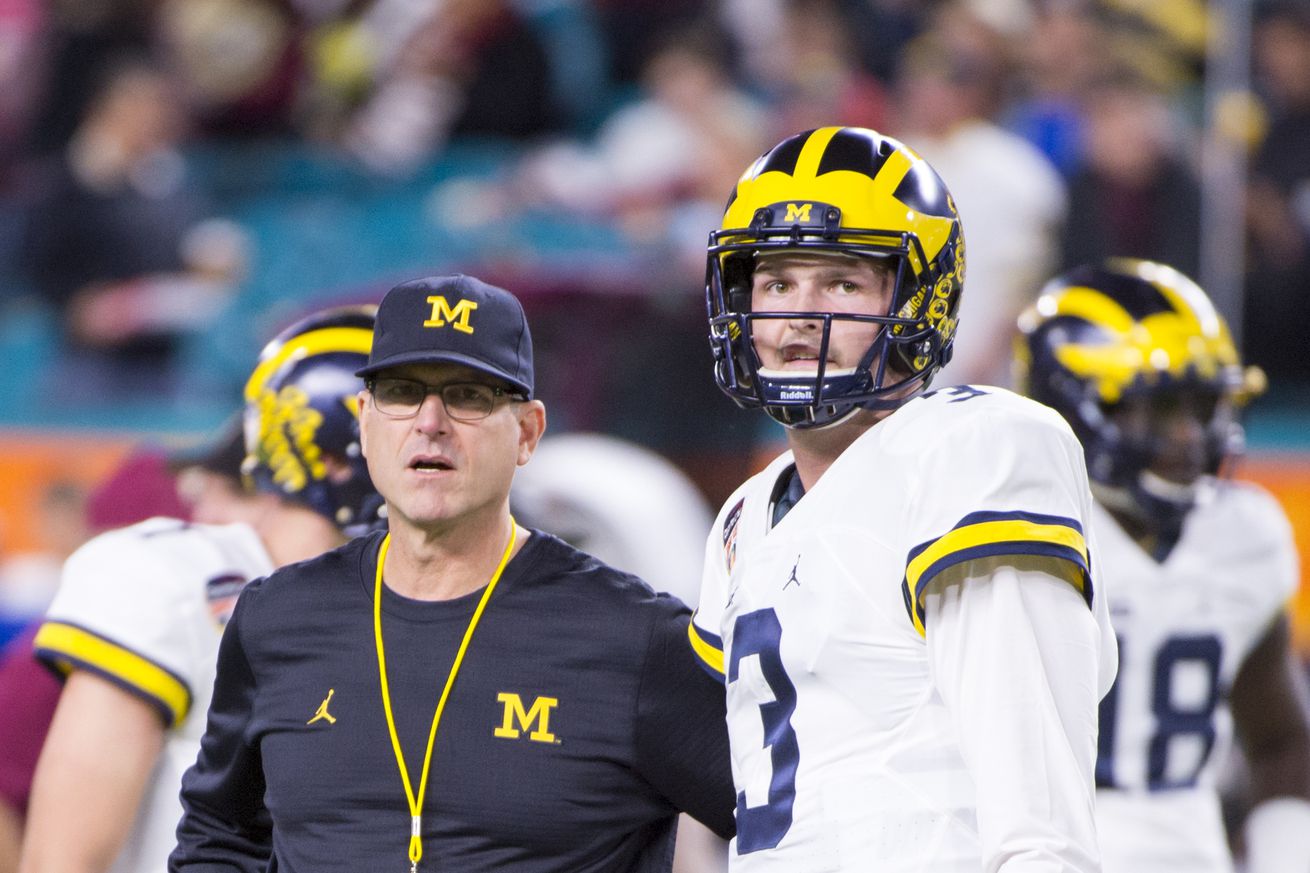
In Jim Harbaugh’s second season, the Wolverines went 10-3 and were a Top 10 team from start to finish. Could Michigan be in for a similar result in Sherrone Moore’s second season as head coach? Let’s evaluate:
The Michigan Wolverines had legitimate championship aspirations during Jim Harbaugh’s second season as head coach in 2016. Now entering his second season, Sherrone Moore has a talented team, but one with a few question marks.
Today, we’ll compare the two squads and ask whether it’s fair for Team 146 to have as high of expectations as in Harbaugh’s second season.
From a roster standpoint, these two teams have some similarities. Both had a quarterback room with question marks, but the eventual starter came into much different circumstances. Wilton Speight won the job in 2016 and was gifted one of the best receiving corps in the country. Amara Darboh, Jehu Chesson and Jake Butt all had more than 500 yards each, and Speight threw for more than 2,500 yards.
Meanwhile, Michigan’s returners from 2024 had only about 800 yards combined last season. They’d have to essentially quadruple their production in 2025 to get to the 2016 team’s production.
The good news is the talent at quarterback is much better this year and the Wolverines should have a better play caller in Chip Lindsey. Assuming Bryce Underwood eventually wins the job, he has far more potential and a much different skillset than Speight. Together with Lindsey, either Underwood or veteran Mikey Keene should help lift the production from the receiving corps to a much higher level.
At running back, the 2016 group had four guys rush for more than 400 yards. The 2025 room has a boatload of talent, too, with Jordan Marshall, Justice Haynes, CJ Hester, John Volker and Micah Ka’apana all expected to play a role. The top two are probably more talented than that 2016 group, so there is plenty to be excited about.
The offensive line featured a mix of veterans and newcomers, with guys like Grant Newsome, Ben Braden, Mason Cole, Kyle Kalis, Erik Magnuson and Ben Bredeson. Similarly, Michigan has a good core in 2025 with Evan Link, Giovanni El-Hadi, Greg Crippen, Nathan Efobi, Andrew Sprague, Brady Norton, and Andrew Babalola. Both the 2016 and 2025 squads have a similar makeup.
There are quite a few similarities on the defensive line as well. A hyped interior defensive lineman with experience (Rayshaun Benny now, Maurice Hurst in 2016), a proven edge rusher (Derrick Moore, Chris Wormley), another pass rusher who many are hopeful can become a star (T.J. Guy, Taco Charlton), and an up-and-comer (Chase Winovich, Cameron Brandt) that made/could make an impact.
The next level also had some studs, with linebackers like Mike McCray and Ben Gedeon in 2016 being represented by Jaishawn Barham and Ernest Hausman in 2025.
Secondary play is by far the largest difference on defense. Right now, it doesn’t appear Michigan has anything like Jabrill Peppers, nor a bona fide All-American corner like Jourdan Lewis. While Jyaire Hill is getting called out as a potential first-round pick, he has a lot to prove to be mentioned in the same breath as the two studs from 2016.
Moving away from the roster, these teams live in very different eras. The 2016 team would have been in the 12-team College Football Playoff. A one-point road loss to Iowa and the J.T. was short game would have left the Wolverines at 10-2 with a spot in the lower part of the seeding, with a win over No. 8 Wisconsin carrying a lot of weight into the committee’s decision-making.
On the negative side, the Big Ten is also much deeper after consuming the best parts of the Pac-12. On top of that, the Wolverines also have a top-25 road contest with Oklahoma in Week 2 and will be without their head coach for what could be a tight game at Nebraska in Week 4. Moore’s path to the postseason may seem easier, but the competition that the Wolverines will face in 2025 is tougher.
Making the CFP seems to be the bar for success in the sport. Ironically, the Michigan 2015 team, after Harbaugh’s first year, also wrapped the season with an emphatic 41-7 win over an SEC team (Florida in the Citrus Bowl). Riding that momentum into a 10-2 season with a team being within a few plays of a championship in Harbaugh’s second year was viewed as a success.
While the odds might be further stacked against Moore in 2025, and the wide receiver and secondary positions may not be as talented, Michigan still has the pieces to make a run at the postseason. It feels like the mark for getting there is 10 wins, just like that 2016 team had. The standard set by that team in Harbaugh’s second year should be a goal for Moore in his second season.