
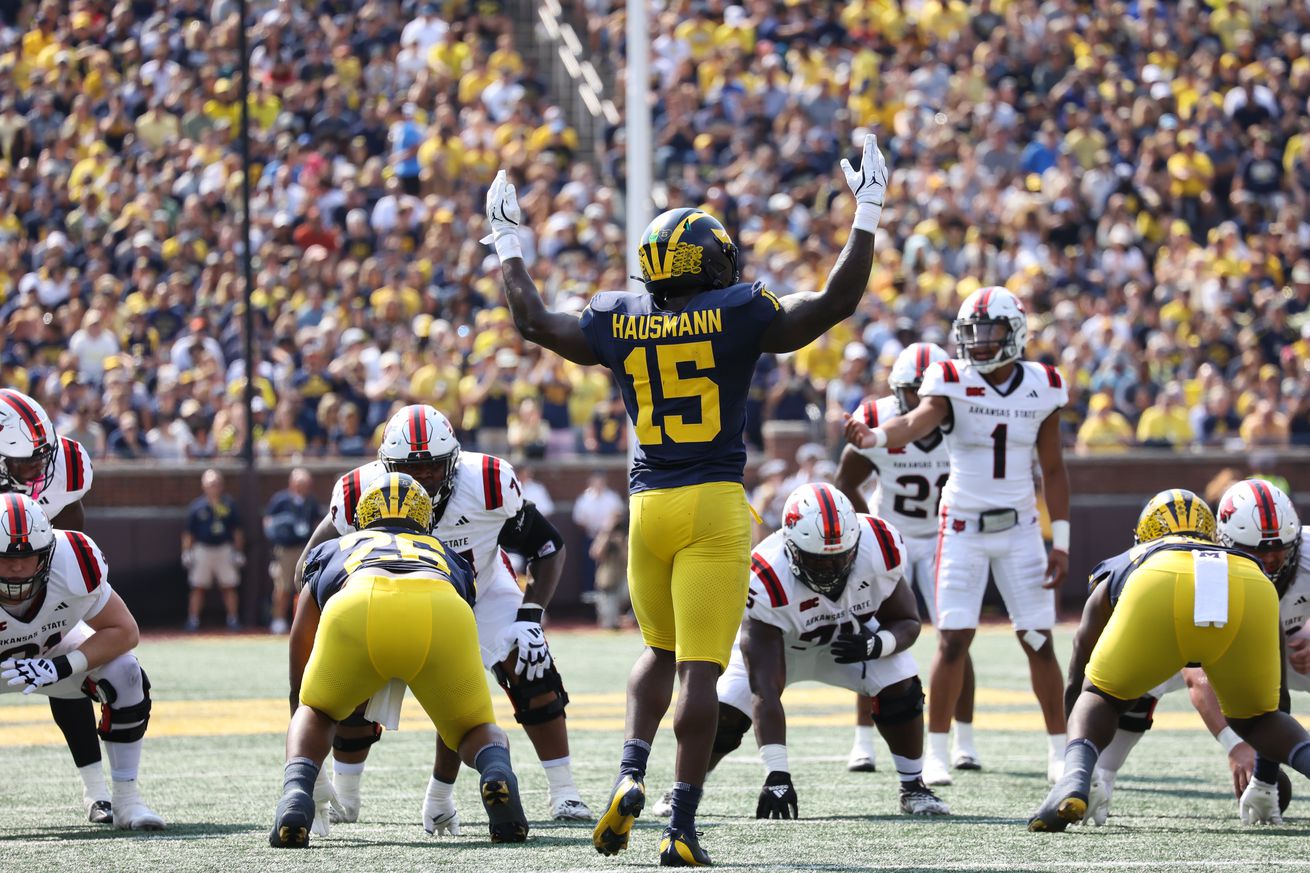
Michigan’s defense was supposed to be dominant, but a handful of frustrating issues have prevented it from being anything other than inconsistent. By examining the film, three key issues emerged that the defense needs to address moving forward:
With the worst offensive passing attack in the Power Four and a unit averaging two giveaways a game, Michigan’s offense has resembled a circus tent fire with various agents setting it ablaze week-to-week. There are more questions than answers for the offense at the season’s halfway point, but in a way, the offense was never expected to be prolific or dynamic this season. Granted, it wasn’t supposed to look anemic and flaccid either, but the offense has been far less disappointing than the defense this year due to being victimized by expectations.
Sky-high projections were placed upon the Michigan defense despite replacing its entire coaching staff and eight starters. With three potential NFL first-rounders on the unit, some speculated that this defense could outperform 2023’s historic output. Even with an offense that is as exciting as the pacer test in gym class, this defense was supposed to be able to shoulder the burden for Team 145. But through six games, the defense has been overwhelmingly inconsistent at best.
Currently, the Michigan Wolverines rank No. 56 in scoring defense and No. 44 in total defense. After (painfully) rewatching every touchdown allowed this season, the issue clearly lies in the secondary. The Michigan defense has allowed 16 total touchdowns this season, 12 of which have been through the air (for reference, Michigan’s defense allowed 17 touchdowns in 15 games last season). However, the underlying issues of this defense are far more complex than declarations “Michigan blitzes too much” or “runs too much man-to-man coverage.”
Admittedly, I have been a Wink Martindale apologist, but I am also not a blood relative. Blame resides equally with the players and the coaches this season. To quote BASEketball , “It was a team effort and it took every player (and coach) working together to lose this one.”
Going through every touchdown, a few explanations became glaringly obvious as the true reasons why this unit struggles to defend the pass: execution and communication. For this week’s film study, I have grouped the passing touchdowns allowed into two categories and we will address the four rushing touchdowns separately at the end. If we must, let’s check the tape!
Coverage Execution
Sometimes, even when things are drawn up perfectly, overlooking the fundamentals of execution can cause a play to collapse. For this analysis, these execution errors are going to be categorized differently than coverage busts. Coverage busts will be blamed more on pre-snap communication than post-snap execution, although they are never mutually exclusive, and busts are technically execution errors in their own right.
Coverage execution has been a problem since the start of the season and has shown up as recently as Washington. The first touchdown Michigan allowed this season came down to executing a single tackle in space.
Fresno State Third & Eight
Fresno State only scored one touchdown against Michigan, but the lone score exposed the bad habit that this defense still hasn’t kicked. Facing a third-and-eight from the 17-yard line, Martindale brings the heat with a creative Cover Zero, five-man pressure, but also drops linebacker Jimmy Rolder as a low-hole coverage defender to discourage shallow crossers. Similar to how Jesse Minter used to drop a defensive tackle to clog up the same throwing window when running Zero.
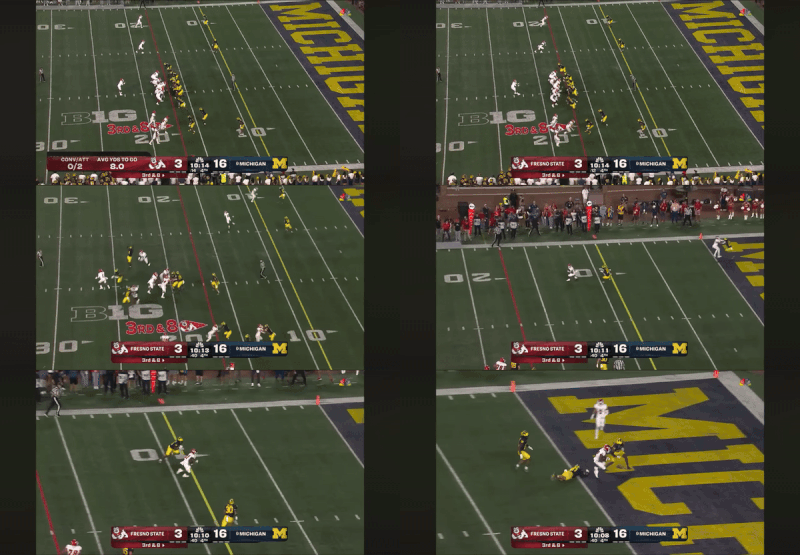
The play goes according to plan from the snap. The pressure forces a quick throw to a receiver running a quick-out and all the defense has to do is make the tackle to set up fourth down. Unfortunately, nickelback Ja’Den McBurrows drifts too far with his coverage cushion – he should be in catch technique with the pressure design – attacks the wrong hip with his pursuit angle resulting in a missed tackle, and forfeits leverage to the inside for an easy touchdown.
Similar tackling woes reappeared against Arkansas State late due to back-ups falling apart and missing multiple tackles in Cover Six . Furthermore, execution is more than just missing tackles.
Twice in the red zone against Washington, technical execution resulted directly in a pair of touchdowns. The first instance came when running Cover Two on third-and-goal and cornerback Jyaire Hill’s technique (and bad luck) led to him slipping and falling in the end zone. The second came in Cover Four from the 16-yard line when a map couldn’t have saved nickel Zeke Berry from getting lost against the slot receiver.
Execution issues struck against Texas when corner Aamir Hall got beaten to the pile-on in Cover One and again when Martindale over-schemed his disguise.
Texas Third & Goal
Execution errors do not always fall on players. In this instance, Martindale and Hausmann share the blame. Michigan comes out with seven players at the line of scrimmage but with safeties positioned as if the defense is dropping into a zone. In reality, the Wolverines are running a variation of Cover Zero with the field-side defensive end also dropping into coverage.
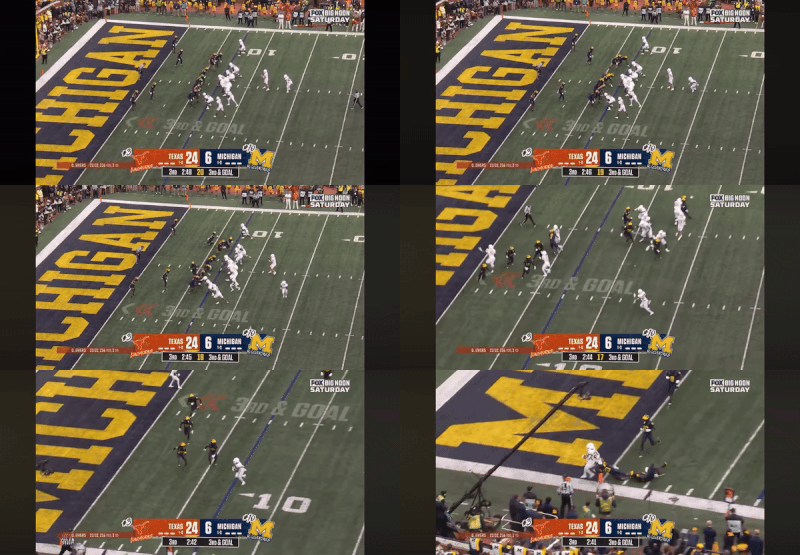
Now, Hausmann appears to be a designed blitzer – if the running back stays in to block – with his pre-snap alignment but he also has the indicator to follow the running back if he goes in motion. The back does go into motion and Hausmann is late to the party.
This could be blamed on Hausmann for mishandling his responsibilities, but I also think this is too much for the young linebacker Hausmann has to work from the A-gap all the way out into the flat and he is just simply not athletically capable of making up this ground even if he had gotten a better jump on the route. However, Hausmann has to shoulder some blame for taking a horrible pursuit angle allowing the back to get to the edge and reach the end zone.
Coverage Busts
There have been more coverage busts this season than in the last two years combined. Or so it seems at least. Against Texas, Jyaire Hill mistakenly chases inside on Cover Six . Reserve corner Myles Pollard was the only defender not playing Cover One against Arkansas State for its first touchdown of the game. Against Minnesota, Michigan’s secondary got confused in a Drop-Eight look against a four-man route concept , and against USC, Michigan busted on all three touchdowns.
The first touchdown again came against Drop-Eight when Zeke Berry and Makari Paige demonstrated the chemistry and connection of J-Lo and Affleck. The second came against Cover Zero when someone forgot to tell Berry it was Cover Zero. The final touchdown came when either Hill or Paige screwed up their assignment.
USC Third & 16
With a chance to all but seal the game, the Michigan secondary picked the worst time to bust. To the top of the formation, Hill is defending against a vertical route. At the snap, Hill is playing like he has over-the-top support and Paige is playing like a deep quarter safety. With the two not on the same page, the bust opens the door for Miller Moss to connect for the go-ahead touchdown.
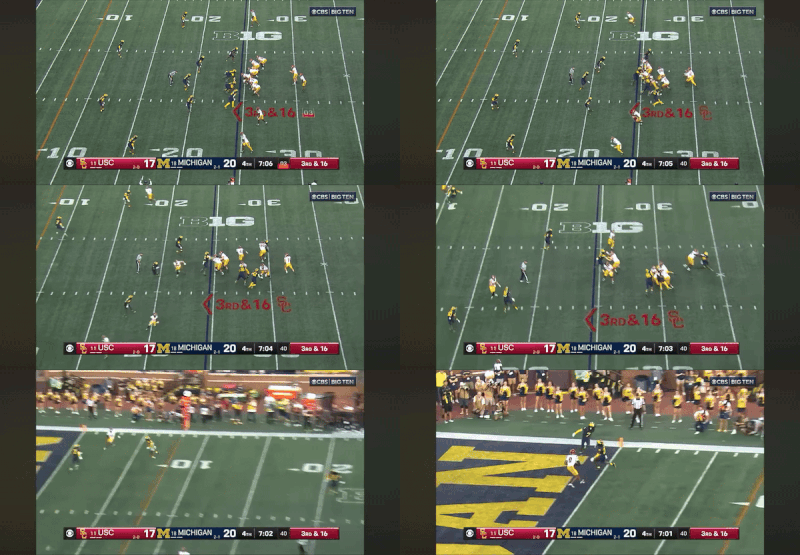
If this is Cover Four, the blame should be solely on Hill for his improper technique, but Paige is still not absolved in my mind. Paige is still there in time to play the ball, hit the receiver, or anything, but he instead uselessly floats over the top like a spectator. Make a play, son.
If this is Cover Six, the blame is with both players because Hill is responsible for getting his hands on the receiver and rerouting him inside, while Paige is solely responsible for any deep shots on his half of the field. Without being inside the huddle, the blame falls on both players.
Run Alignment
One definitive strength of the Michigan defense this season has been the run defense. The Wolverines are currently nationally ranked No. 3 in rush yards allowed per game (76.33) and second in total rushing yards allowed this season (458). However, no unit is perfect.
Michigan was a victim of a pin-and-pull against Texas and Washington’s Jonah Coleman went over the top at the goal line to reach the end zone for the Huskies. Facing Minnesota, two first-and-goal runs brought the Gophers back into the mix after stumbling out of the blocks. The first rushing touchdown allowed to Minnesota was due to poor block destruction and a bad run fit from the safety . The second was due to improper alignment, which has shown up numerous times this season in short-yardage situations, especially against tempo.
Minnesota First & Goal
Before the ball is snapped, the defense needs a timeout. Following a momentum-shifting, field-tilting 60-yard punt return, the Michigan defense is fighting a wildfire with a squirt gun. Following the return, boom, nine-yard pass completion, and Minnesota’s hurry-up offense is activated. Boom, four-yard gain to set up first & goal for the Gophers. Boom, Minnesota is lined up and looking for pay dirt.
Sherrone Moore should have come sprinting with a time-out at this point. Gather the team, take a breath, and reset before a critical goal-to-go sequence. Instead, it plays out like this.
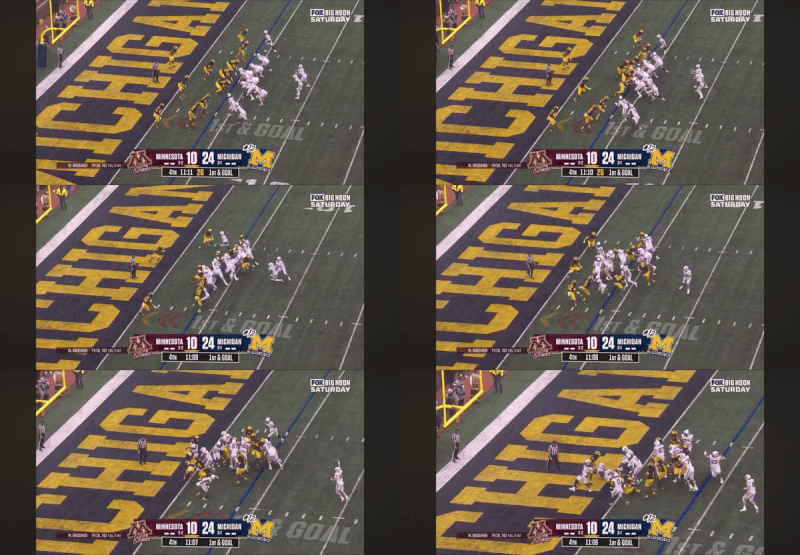
From alignment, I am flabbergasted at what this could be. Look at this alignment. Ernest Hausmann is lined up almost as the boundary corner but in an edge-rushing SUPER WIDE technique. Seriously, what is this?
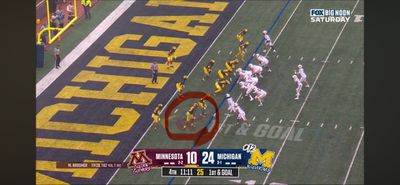
In doing so, there is no edge to the near-side of the defense. The C and D gaps are completely uncovered with only the hope of filling those being Makari Paige transforming into prime Ray Lewis.
At the snap, Minnesota unsurprisingly gets a great push on the uncovered gaps and works up to the second level. Zeke Berry seems like he has a chance to make a play in the backfield but his fatigued effort wouldn’t have counted in two-hand touch. Linebacker Jaisahwn Barham busts through the back side and if an edge had been set to cause even a quarter-second delay he could have made the play. Lastly, free safety Quinten Johnson fills the gap in just enough time to be flattened like an ACME cartoon at the goal line.
This comedy of errors could have been avoided if the Wolverines had just set the edge by aligning properly.
Possible Solutions
Move Will Johnson to Nickel
Similar to how the Wolverines used Charles Woodson in the 90s, Dax Hill in 2021, and Mike Sainristil the last two years, this position switch could drastically raise the ceiling of the entire defense by making its best player unavoidable.
As Michigan has seen so far this season, offenses can scheme around Will Johnson at boundary corner. However, it is impossible to scheme around a dynamic nickel. “CTRL + F” and look at how many times “Berry” and “McBurrows” were mentioned above.
Nickel is a massive issue for this team and contributed to Michigan’s secondary being the weakest up the middle. The insertion of Will Johnson would immediately address this need and remove Berry – the weakest player in the secondary – from playing such a critical role.
The back end is never going to be elite for the Wolverines, but by moving Johnson to nickel and having Aamir Hall take over his boundary spot, I promise this unit will improve upon its No. 111 pass defense ranking.
Simplify, simplify, simplify
Instead of trying to find ways to scheme and disguise a plethora of different defenses, Martindale and his staff need to simplify this down to a handful of base calls with key pre-snap adjustments. Communication has been a major issue for this group and simplification would at least allow the defense to align properly and play fast. Thinking too much has been half the battle. Does this lower the secondary’s ceiling? Yes, but it also dramatically raises the floor and mitigates the negative impact of the secondary’s weakest parts until they can build the prerequisite confidence to play at a higher level.
Glass Half Full
Everything with this defense is fixable. Going back through the film was more frustrating than anything because this defense is close. Execution can be sharpened with a focus on details, busts can be mitigated with communication, and run fits can be solidified with experience. The preseason expectations were unfair, but this defense is too talented to be receiving the results it did in the first six games.
It will take a team effort and every player (and coach) working together to fix this one, and it starts Saturday against Illinois.