
With the House vs NCAA settlement set for preliminary approval, revenue sharing and NIL discussions have reached Dusty May and #Michigan basketball. It may be his first season, but May has plans in place to stay competitive:
There are many ways to revitalize a college basketball program in the current age of NIL and the transfer portal. For the Michigan Wolverines and head coach Dusty May, turning an eight-win team the year before into a “really good basketball team” that competes for championships is not an easy feat.
May hit the transfer portal hard his first offseason at Michigan, bringing in nine transfers and three freshmen while retaining three players from last year. With the first game around the corner, he is already looking towards the future (both near and far) to bring Michigan basketball back to the forefront of the sport.
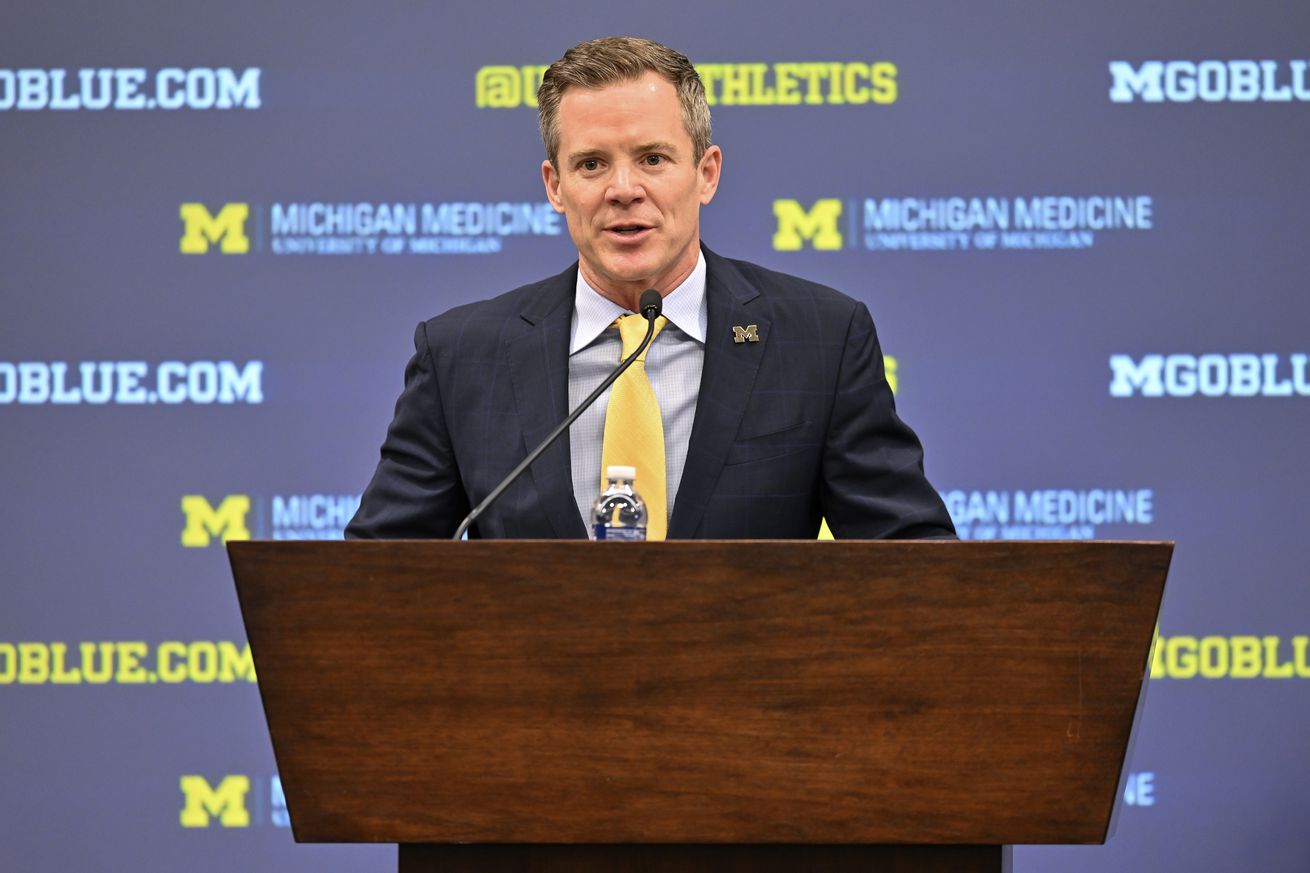
The first thing May recognized in his press conference on Friday was the availability of NIL resources the Wolverines have, and now, the potential of revenue sharing.
The landmark House vs. NCAA settlement surrounding the payment of collegiate athletes received preliminary approval from the U.S. District Court on Oct. 7. This knocked down another barrier for athletes to be compensated while also creating the possibility of revenue sharing. The final approval is set for April 7, 2025.
Michigan athletic director, Warde Manuel, recently discussed the possibility of in-stadium advertising for the Big House to support the Wolverines’ competitiveness with revenue sharing, and more changes could come to the basketball program as well.
“We discussed it,” May said. “But before there’s a concrete answer — and even all my questions are usually prefaced with, ‘I’m not going to hold you to this, but what do you think as of today it’s going to look like?’ And most of the answers are, ‘It’s still too early to tell.’ There’s people working on that because you don’t really know. There’s a couple of different directions that it could go. What are we looking for? We’d like to have one of the top budgets in the Big Ten and in the country to have the ability to retain our roster and help attract other high-performing players and driven players. But no, there’s nothing concrete, but we’ve had several discussions.”
If the settlement is be approved, Michigan’s basketball program would increase its scholarship number from 13 to 15, adding a huge advantage to the recruitment process. Between NIL evaluations, the transfer portal being open to any athlete, and now a potential base salary with revenue sharing, May has many resources to field a competitive team every single year.
In his first offseason, May was able to retain Durral “Phat Phat” Brooks as the only commit to stay with Michigan, flip LJ Cason from Florida Atlantic, and convince Justin Pippen to commit to the Wolverines. It is not easy to recruit three highly-touted guys in four months, but May was methodical and diligent to get these guys in Ann Arbor.
“We were aggressively recruiting a lot of high school players because we believe in what Michigan has to offer,” May said. “We believe in our ability to develop relationships, help players get better, and we think those things will play a part in retention. Obviously, then you factor in the NIL dollars and the opportunities off the court … we might be a little bit naive, but we think we can continue to help guys get better and retain talent. So for us, it’s not just one year, but obviously we always have to be one eye looking towards the future, while the other eye looking towards the very near future.”
It’s clear that May and the program have a plan in place to be able to not only recruit the best players possible, but also retain the talent they already have. Whether they are able to successfully do that year after year or not is still to be determined, but it’s reassuring they know what they must to do become and stay competitive in today’s college basketball.