
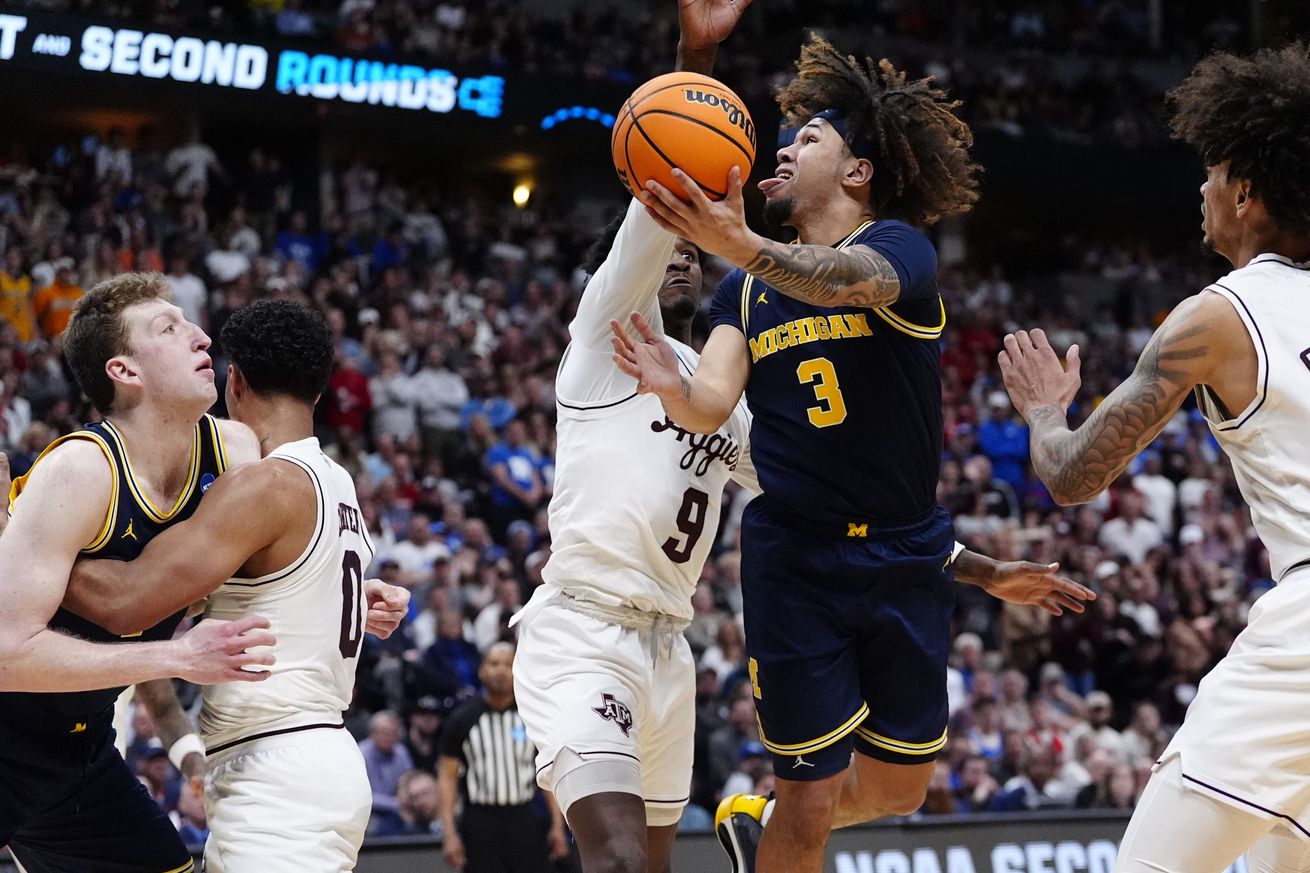
The 1-seed Auburn Tigers are heavy favorites according to oddsmakers, but the Michigan Wolverines have a slight advantage in some key advanced statistics:
The NCAA Tournament continues this weekend, with the 5-seed Michigan Wolverines taking on 1-seed Auburn in Atlanta Friday night.
Looking at odds on FanDuel , the No. 1 overall seed opened as a 9.5-point favorite, with the line moving a point in Michigan’s favor in the days since. As of Tuesday morning, you can now bet Michigan -8.5 at -108, or take Michigan moneyline at +300 if you think the Wolverines can pull off the upset.
KenPom, the advanced statistics bible of college basketball, projects an 80-72 win for the Tigers . After watching this team all season, I have a feeling Michigan is in for another tight one and will make this game a bit more thrilling than projected.
To craft a recipe for the Wolverines pulling off the upset, let’s dive into stats that showcase four areas where Michigan may have an advantage. We’ll also take a look at where Auburn has the upper hand.
A quick pace of play
Adjusted tempo: 58th for Michigan, 146th for Auburn
The Wolverines are at their best when playing fast, with easy buckets in transition propelling the offense and lengthening key runs.
The Wolverines play a bit faster than the Tigers on average, with the average offensive possession being more than a second quicker for Michigan (16.0 seconds, 22nd in the country) than Auburn (17.3 seconds, 132nd). When comparing that to the length of defensive possessions (18.0 for Michigan opponents, 17.7 seconds for Auburn opponents), Michigan’s offensive possessions tend to be two seconds faster than defensive possessions, a 1.7-second difference over Auburn.
This may not seem like a big difference, and stops created by the Tigers can be the reason for those quicker defensive possessions. But those seconds add up as the game goes on. And the more possessions you have, the more chances you have to score.
Michigan will need to give itself as many extra possessions as possible, limiting turnovers while grabbing offensive rebounds and steals to swing the possession count. Michigan playing fast and thriving in transition feels like a requirement to pull this upset off.
Getting to the free throw line, and scoring when you get there
Free throw point distribution: 155th for Michigan, 218th for Auburn; Free throws attempted/field goals attempted: 103rd for Michigan, 149th for Auburn.
What that first stat means is a higher percentage of Michigan’s points (19.3 percent) than Auburn’s points (18.3 percent) come at the free throw line. While that’s not a statistically significant difference, Michigan draws more fouls, which leads to more opportunities for points. Among the more than 5,000 players in the database, three Wolverines are ranked in the top-500 in the country in Fouls Drawn: Vlad Goldin is 42nd (6.3 fouls drawn per game), Roddy Gayle Jr. is 443rd (4.4) and Danny Wolf is 499th (4.2).
Auburn’s two leading scorers, Johnni Broome (5.7, 97th) and Chad Baker-Mazara (4.6, 350th), also draw a good amount of fouls, but Michigan appears to have an advantage when it comes to getting to the charity stripe and getting opponents in foul trouble. Forcing Bruce Pearl’s hand and getting either of those two on the bench with foul trouble would certainly help.
It’s also important to note the Tigers (73.2 percent) shoot a little better from the free throw line than the Wolverines (72.7 percent). That said, through two tournament games, Michigan has shot 66 percent from the free throw line, while Auburn has shot 61 percent. Making a higher percentage at the line increases Michigan’s chances of victory.
Defense inside the arc
The Wolverines are slightly better at preventing makes on two-point shots. Michigan holds opponents to 46 percent from inside the arc (13th), 1.2 percent better than the Tigers (44th). Michigan also has a very slight 0.1 percent advantage when it comes to block percentage.
To summarize in layman’s terms, the Wolverines are slightly better at preventing makes in the paint and from mid-range. We know the Wolverines can protect the rim, and rotations have gotten better as the season has come along. Michigan’s average height being nearly an inch taller also helps.
The teams are only separated by 0.3 when looking at adjusted defensive efficiency, but that slight advantage inside the arc can help Michigan. Forcing misses around the rim has been one of Michigan’s biggest strengths, and it will certainly lean on that in this game.
Assisting on baskets
Michigan does assist on a higher percentage of its baskets (58.6 percent, 44th in the country) than Auburn (55.1, 99th).
Sharing the ball and creating open opportunities through that ball movement is a core principle of May’s offense. Michigan’s best offensive games have been in games where 4-6 players score in the double digits with a multitude of assists to create easy baskets.
Michigan also has two top-50 players in effective field goal percentage — which accounts for the extra point value of three-point shots to two-point shots — Goldin (63.2 percent, 26th) and Nimari Burnett (61.5 percent, 50th). If those two knock down shots at an efficient rate, chances are Michigan is playing Auburn close.
A quick summary of Auburn’s biggest advantages
Admittedly, there aren’t many advantages Michigan has, with KenPom giving Auburn the upper hand in almost every advanced stat. Here are some of the biggest advantages:
- Auburn turns over the ball about six percent less, with the Tigers being fifth in the country in an area that may be Michigan’s most glaring flaw (324th in the country).
- When looking at non-steal turnover percentage — in other words, what percentage of turnovers are unforced mistakes — Auburn is second in the country (4.6 percent) and Michigan is 343rd (9.4 percent).
- You’d think offensive rebounding rate would be a huge advantage given Michigan’s size, but Auburn grabs its own misses at a more efficient rate with a one percent difference in that category.
- Auburn played a stronger schedule (second) than Michigan (16th), with Auburn playing more bench minutes, possessing more DI experience, and having much more minutes continuity (40th to 265th). In other words, Auburn is deeper, has more experience, and has spent more time playing together. That last category is obvious considering all the transfers Michigan has, but Auburn’s chemistry will be crucial down the stretch of this game if it’s close.