
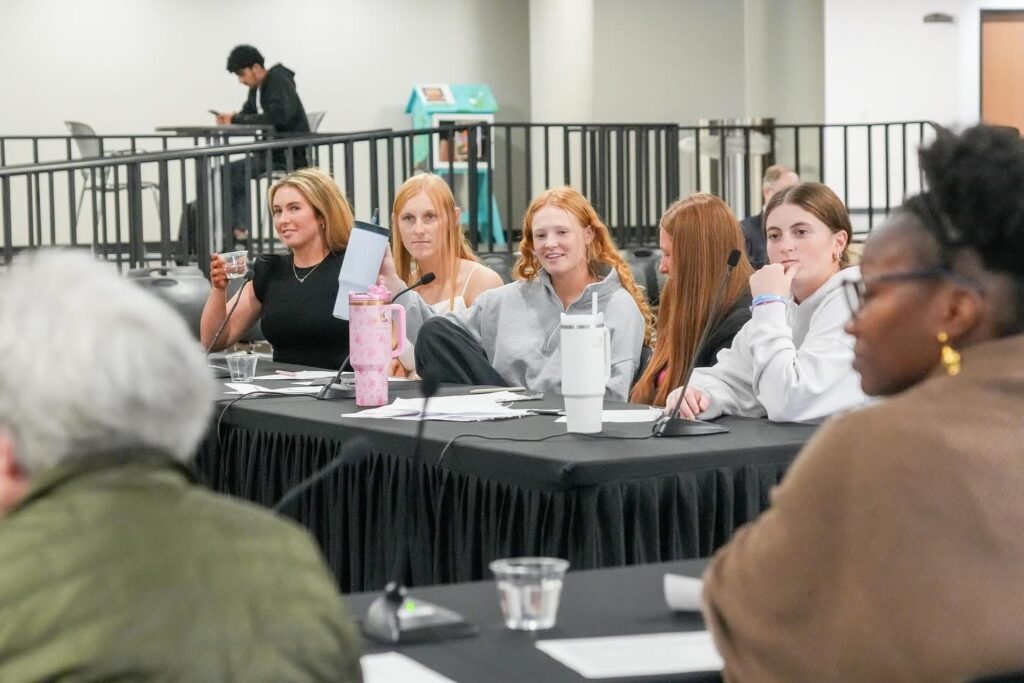
A team of five University of Detroit Mercy softball players proved that preparation and teamwork extend beyond the field when they won the Detroit Mercy Ethics Bowl on Oct. 31.
The winning team, fittingly named Ethical Estrogen, consisted of Abby Klaft, Mia Hubble, Alison Fluke, Erin Flynn and Liv Peterson. The Division I athletes balanced a demanding practice schedule while preparing for a competition centered on ethical reasoning, argumentation and collaboration.
Klaft, the only team member interviewed, said her decision to participate began in the classroom.
“What interested me was it was offered through my ethics class and my teammates were going to be doing it, so I figured that I would join,” she said.
Despite busy schedules, the team found ways to prepare together.
“We sat down as a team and decided that we needed to start reviewing,” Klaft said. “We made a couple of times in between classes and practices and we cranked out our preparation.”
Their athletic background played a key role in their success. Klaft explained that the mindset needed for softball directly translated to the Ethics Bowl.
“Just the preparation for a competition is the same as preparing for an ethics bowl,” she said. “It was easy to just be prepared and ready to work on the cases.”
In preparation for the competition, Ethical Estrogen divided responsibilities based on individual strengths.
“We met a couple of times, and we divided a plan as to who was stronger in some areas and what cases resonated with us the most,” Klaft said.
The group also focused on strengthening their rebuttals by identifying gaps in their understanding and researching unfamiliar topics.
Interestingly, Klaft noted that the team dynamic worked differently in an academic setting than on the softball field.
“We worked together better academically actually because softball we all play different positions and focus on different aspects of our game,” she said. “The Ethics Bowl allowed us to really utilize our strategies from having to think outside of the box.”
The team realized early on that they had a strong chance of winning.
“After the first case we won, we were like, ‘wow, let’s do this,’” Klaft said. “We really wanted to win because all of us are so competitive.”
The cases presented at the Ethics Bowl addressed real-world issues, including whether governments should limit what SNAP recipients can purchase with food assistance and whether countries should restrict where tourists are allowed to visit.
Martin Leever, director and a judge of the Detroit Mercy Ethics Bowl, praised the team’s performance.
“Ethical Estrogen was a very balanced team,” he said. “They did very well in teasing out the values in play in each case.”
For Klaft, the experience reshaped how she thinks about ethics in everyday life.
“It changed my mind on how such little everyday decisions can impact a lot of lives,” she said.
She added that the competition influenced how she hopes to approach future choices in her career, aiming to positively affect others.
Ultimately, the victory was about more than just winning.
“It was fun to win, especially with my teammates who also are super competitive,” Klaft said.
Ethical Estrogen’s Ethics Bowl win represents the versatility of Detroit Mercy student-athletes and shows that critical thinking and teamwork are skills that matter both on and off the field.